Reflections on Ghana 2024: Tackling Modern Slavery Together
30th September 2024
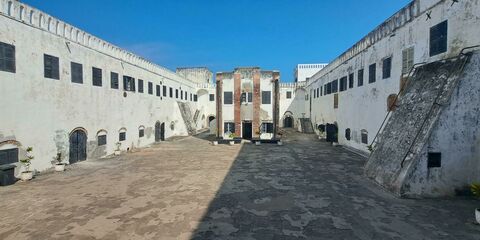
The international conference workshop on “dealing with the aftermath of the slave trade and slavery” is took place in Elmina Castle on the Gulf of Guinea in Ghana.
Elmina Castle, also known as St George Castle, was the first trading post built on the Gulf of Guinea by the Portuguese in 1482. Named after the patron saint of Portugal, St George’s Castle enabled the Portuguese to build a trade monopoly in the area, giving unrivalled access to the region’s gold. By the time the Castle was captured by the Dutch in 1637 slaves had become the principal trade. The castle became the headquarters of the West Indies Company for the next 250 years and remains the oldest European building in existence in Sub-Saharan Africa.
Each dungeon, one for women and one for women, would hold hundreds of people chained together until they were eventually led to the door of no return, the portal through which slaves were forced onto ships. Precise numbers are difficult to gauge as children were not counted and many died before passing the door of no return, but over 12.5 million slaves were forced onto ships to cross the Atlantic (the Middle Passage). By the 18th century 30,000 slaves on the way to North and South America passed the door of no return in Elmina Castle every year. The floors of the dungeons were covered in dirt and excrement, as the captive slaves could not leave the dungeon until forced onto the slave ships, with yellow fever, malaria and other diseases rife. Outside the women’s dungeon is an open space where the governor of Elmina Castle would regularly select from the captives women someone to take to his quarters to rape.
While Elmina Castle is the oldest and largest of the slave castles in West Africa it is only one of dozens built to hold the millions of Africans enslaved and transported to the Americas.
Dr Kwame Adum- Kwemereh, Head of the History Department at the University of Ghana, put the transatlantic slave trade in the historical context where slavery in Africa both existed and was widely accepted on account of the important role slaves played. He pointed to three specific slave trades: the East African slave trade to the Middle East between 1500-1800, the trans-Saharan slave trade for gold and salt from 200BC to 1800s and the internal indigenous slave trade running since 10,000BC.
Dr Adum-Kwemereh argued that this internal indigenous trade had three components: to provide slave labour in agriculture and trade; prisoners of war who were always enslaved; to serve kings in their courts. He pointed to the protests by Asante kings formally protesting in 1906 the end of the slave trade.
While this was the historic context, delegates argued that the transatlantic slave trade was of a different order in both cruelty, the numbers involved, the racist philosophies that developed to justify it and the malign effects on societies across the Western Hemisphere that continue to this day.
Challenging the role of the Catholic Church in the slave trade was the focus of an extended session led by Fr Chris Kellerman, SJ, who had been tasked by the Holy See’s Dicastery of Integral Human Development to explore the Church’s approach to slavery. As a starting point, Fr Kellerman pointed to the 20,000 slaves held by the Jesuits across the Americas in 1760. Given the recent insistence by successive Popes that the Catholic Church had always condemned slavery as anti-Christian, how was this Jesuit slave holding possible?
However, the history of the Catholic Church demonstrates that the Jesuits’ slaves were no anomaly as Fr Kellerman’s argued. Slavery was repeatedly defended by Augustine, Aquinas and Popes as it was part of wider society. Aquinas even argued that slavery was part of natural law. Prior to 1400, Catholic Europe accepted slavery, defended slavery in theology, even incorporating slavery into Canon Law. Following the first slave raids in Africa by Portuguese Henry the Navigator , Pope Nicholas V explicitly gives Portugal the right to take lands, possessions and people of non-Christians. This permission to continue slave raids was renewed by the next three Popes, including Leo X in 1514 (over 30 years after Elmina Castle was built). In the sixteenth century protests from a small number of priests were dismissed and the protestors removed from post, while Jesuit theologian Luis de Molina developed the argument of just and unjust slavery. He called for a duty to investigate, but the presumption should always be of just slavery; and never to ask the slaves themselves as they would lie! St Peter Claver, SJ, was the community slaveholder and the Vatican held a number of slaves; the last of whom was only freed in 1804…
In 1680’s representations from Brazil’s black Catholic communities went to Rome to protest. This was met by a doctrinal statement that there was no illegal slavery and there was no Papal condemnation. After approaches from the United Kingdom which had led moves to abolition of the slave trade, it was only in 1839 that Pope Gregory XVI condemns the slave trade, but not slaveholding itself. However, Pope Gregory XVI falsely claims that the Catholic Church had always been against the slave trade. In 1866, the Holy See’s doctrinal body states that slaveholding is morally acceptable, in accordance with natural law and from the Bible. In 1888 when Brazil finally abolishes slavery, Pope Leo XIII publishes two abolitionist encyclicals stating slavery is morally evil and incompatible with Christianity. However, he also falsely claims the Church has always been against slavery. This decision not to accept the Church repeatedly argued in favour of slavery and gave permission to Catholic Europe to continue with the transatlantic slave trade until well after abolition has been repeated by all successive Popes.
Fr Kellerman concluded with an appeal for the Catholic Church to come to terms with its past, tell the truth and acknowledge its central role in facilitating the slave trade; for the decision made over and over again not to condemn the slave trade is moral choice.
Cardinal John Onaiyekan, retired Archbishop of Abuja in Nigeria briefly joined the conference as he was leading a group around Elmina Castle. While encouraging reflection and reconciliation, he queried whether the focus on the aftermath of the transatlantic slave trade was enough.
"What aftermath? We should be concerned about slavery today in all its forms."
Cardinal Onaiyekan has been part of the Santa Marta Group since its launch in 2014.
Santa Marta Group’s Role
For the Catholic Church, the eradication of modern slavery and the pastoral care of victims is a priority. The Santa Marta Group was developed in response; born of the conviction that bringing decision-makers together, building partnerships and co-operation between law enforcement and the Church, brings huge benefits in fighting this crime and caring for its victims (for example: rescued victims of trafficking will often run away scared as they have no documents; they are illegal; they have committed crimes; might not speak the language and often come from countries where trust in the authorities, in the police is difficult if not dangerous. If they are cared for, they will make better witnesses at trial leading to improved conviction rates of criminal traffickers; the Catholic Church has a global moral voice and a local presence across the world making connection with local and world leaders authentic and powerful). When the former head of the UK’s Metropolitan Police was challenged by a journalist on why the police was working with the Church, he said: “Human trafficking is a global criminal network of evil and to combat it seriously we need a global network of good. That is where the Catholic Church comes in.”
The Santa Marta Group first met in Rome in 2014 when police chiefs and Catholic bishops came together, in the presence of Pope Francis, to sign an historic declaration, committing themselves to a partnership to eliminate human trafficking. Named after Pope Francis’ residence, in which delegates stayed, the Santa Marta Group has recently become a registered charity and now works in over 25 countries. At its launch, Pope Francis said this was a priority and personally requested Cardinal Vincent Nichols ensure the work continue and be developed. There are already many impressive and dedicated efforts to tackle human trafficking, especially Religious Sisters who have cared for victims of slavery for decades. However, the role of the Santa Marta Group is different. Rescuing, rehabilitating and reintegrating victims is essential but we can’t wait for the crime to be committed and then try to deal with the aftermath. We have to go upstream and address the crime at source.
The guiding principle of SMG is to bring together decision-makers and leaders from the Church, law enforcement agencies and civil society to create partnerships to eradicate modern slavery. Identifying the right leaders, building trust between the decision-makers, and encouraging co-operation and the sharing of good practice is the Santa Marta Group’s task. Focused energy, absolute dedication, and major resourcing are needed to achieve the transformational change necessary to end modern slavery. Combatting human trafficking and slavery presents a multi-faceted challenge. The task is not only to tackle supply, but also, to stop demand, cleanse supply chains, and break up criminal groups who profit from this trade, all while caring for the survivors. With its global network, the Santa Marta Group is focused on this challenge. By acting as a catalyst engaging leaders within civil society, law enforcement, and faith groups, the Santa Marta Group plays a unique role in this effort; one recognised by the UN and governments. Building trust between these markedly different groups is challenging but essential, as ending modern slavery will only come through more effective partnerships and committed moral leadership.
Many countries have anti-slavery legislation, yet very few enforce those laws with vigour. Currently, only 1 in 7,000 (0.2 percent) of all estimated trafficking offences around the world result in a criminal conviction. The Santa Marta Group premise – that international trafficking of human beings will only cease when societies and their governments take decisive action against criminal networks (and society involves government, business as well as citizens – remains true. And so we push for agencies of State to fulfil their commitments on ending slavery – and while police need to be given the resources to take on the criminal gangs, police also need to be assisted when investigating vulnerable communities and in following the non-prosecution principle of victims). Supply chains need to be policed, existing legislation enforced and the problem addressed creatively (eg ethnic chaplains are able to reach out to vulnerable communities, such as the Vietnamese in East London and Fr Michael will know the large Ghanaian community in London. In London alone there are over 50 ethnic chaplains able to reach those vulnerable communities that even consulates will struggle to reach; check flight manifests and see who is booking for multiple flights for women from countries such as Nigeria – the major source of women forced into prostitution in Berlin and many other European cities; use technology to uphold human dignity rather than to exploit people. AI, or better described as machine learning could be used to recognise patterns of trade and criminal activity as well as investigate supply chains effectively and quickly). Our role is not to act as a head office with a one size fits all approach. It is to act as a CATALYST, building trusting networks of leaders to collaborate, to work with police and other authorities. Curbing demand is clearly part of the answer (if a car wash costs a quarter of what it normally costs, something is wrong; sexual exploitation is wrong and on it goes). Awareness raising in vulnerable communities to dry up the supply is another part of the answer. However, as this is a crime hidden in plain sight that we often cannot see or even recognise when we do see, this is not enough. How can we tell if the king prawns a the hotel buffet are not sourced from slaves? How can we tell if the cobalt in our lithium batteries for our phones and computers has been sourced from mines that do not force children to work as slaves? The simple answer is we can’t, but governments and their agencies can and that is why SMG seeks to encourage Church leaders to work with business, law enforcement and civil society leaders. Build those trusting relationships. It takes time and often there are diverging priorities, but as Pope Francis call on us: “get your hands dirty”. It is in businesses long-term interests to operate legally and it is in government’s interests to insist that it is incumbent on all businesses to ensure that their supply chains are slave-free. Indeed, the European Union introduced a supply chain directive earlier this year making it a legal requirement for all businesses operating in Europe to ensure that their supply chains are slave-free. SMG is looking to work with others to push for Tech companies to clean up their act and not put their products at the service of criminals. They can adjust the algorithms that govern the digital world. They have created technology that is not neutral (they have managed to dupe governments across the world that they are neutral platforms so what would be illegal in print or on the street is legal online. But this is changing – as the EU and the US move to clip their wings with online regulation).
This does require a reset in the way that capitalism operates, moving away from short term profit at the expense of long term development, the environment and indeed people. A point I would add here is that the G20, which accounts for 75% of world trade, collectively imports almost $500bn a year of at-risk products. The top five at-risk products are electronics ($240bn), garments ($150bn), palm oil, solar panels and garments each worth between $10-20bn.
To fulfil the challenging mission of abolishing modern slavery and human trafficking, the Santa Marta Group has developed and refined its Strategic Plan, focusing on six critical areas:
- Slave-proofing government procurement, supply chains, and changing business culture (quarterly reporting, profit focused, it should be in their interests to act within the law and have a longer term view.
2. Stopping “Tainted Money”; a commitment that no-one should profit from human trafficking & modern slavery. The Magnitsky act from the USA offers a way forward where individuals and companies and governments involved in human rights abuses can be sanctioned by the US (travel bans and frozen assets making individuals accountable and preventing them from flying under the radar and profiting from slavery). Remember the $240bn figure (and that is not counting the tainted money profits). That has to be laundered somewhere and the major international banks and legal firms that off-shore shell companies that launder the criminal profits that come from slavery are responsible and should be held to account.
3. Legislating to ensure that the internet serves as a responsible technology upholding human dignity. Big Tech are now the largest companies in the world. Facebook made net profits of $39bn last year and has been downloaded 5bn times. Apple and Microsoft between them have market capitalisation of over $6.5trn. Apple made profits of $170bn in 2022. They can and should pre-moderate posts. Algorithms should promote human dignity and not undermine societies by amplifying hate (based on the simple fact that extreme emotion sells as it attracts more eyeballs in the jargon of advertising). The business model is wrong and must change. Adding a safety app is not good enough. After all, you don’t add brakes as an optional extra when buying a car…
4. Remaking and enforcing international legal instruments to make them relevant for today’s world
5. Ensuring international institutions promote human dignity
6. Resetting the moral compass so that slavery is recognised for the evil we know it to be. This is about moral choices and a culture of indifference needs to change. Our belief is that people are tempted to be good and where there is exploitation we must forge partnerships and demand change.
human trafficking is a scourge, a crime against humanity; it is a wound on the body of Christ. We must learn to cry again; to recognise the suffering of the victim and then we will know what to do
Ultimately this is a moral choice. Are we willing to live in a world where one man is superior to another and the weak and poor are abused, raped and all human agency removed purely for our benefit? Where Al, Sophie and 50 million other women, men and children are treated as commodities for the greed of criminals and also our own negligent complicity? Human trafficking and modern slavery remains one of the moral challenges of our time. Ignorance is no defence. Continuing to allow slavery in our midst; hidden in plain sight is a shame on all of us. We cannot claim ignorance. This is a moral choice and the way forward is to build coalitions and partnerships. The Catholic Church is ideally and uniquely placed to do this. We must take the lead.
As Pope Francis said at the launch of Santa Marta, human trafficking is a scourge, a crime against humanity; it is a wound on the body of Christ. We must learn to cry again; to recognise the suffering of the victim and then we will know what to do…